
Flagstone vs Pavers: How Do You Choose on the Monterey Bay?
Flagstone is natural stone of uneven shape and thickness, set in mortar on a slab or laid dry on base. Concrete pavers are factory-made units of one size and thickness, set on compacted base and sand inside an edge restraint. Which one is better depends on the look, how it is built, drainage, where it sits and local rules.
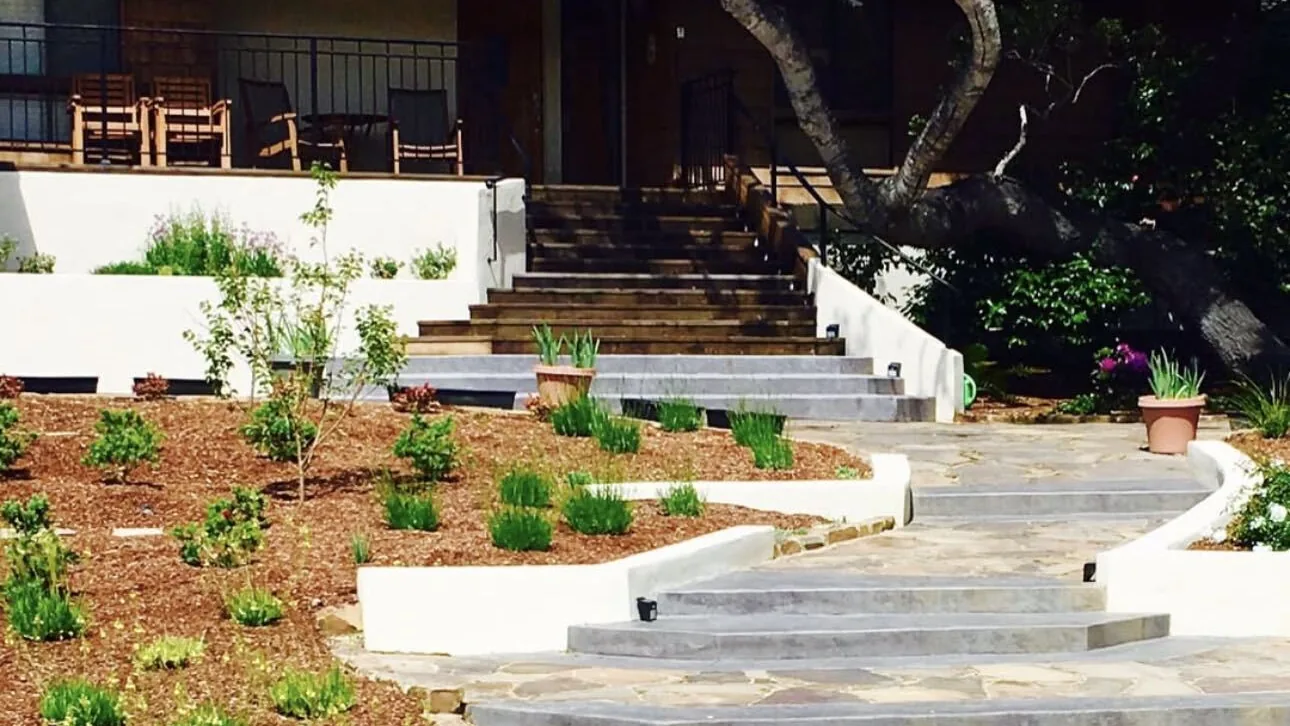
We build both paver patios and flagstone patios and walkways across the Monterey Bay area. Our jobs include a paver patio under a wood pergola on stone column bases. They also include mortar-set flagstone landings with poured concrete steps under oaks.
How do flagstone and pavers compare side by side?
| Flagstone | Concrete pavers | |
|---|---|---|
| What it is | Natural stone split into flat slabs of varied shape and thickness | Factory-made concrete units of matching size and thickness |
| How it is set | In mortar on a concrete slab, or dry-laid on a compacted base | On a compacted base and a sand bed, inside an edge restraint |
| Surface | Fitted irregular joints and a natural split face | A laid pattern, with borders and curves cut in |
| Drainage | Mortar-set stone sheds water. Dry-laid stone lets some rain soak in | Sand joints let some rain soak in. Permeable pavers are built for it |
| Repairs | Dry-laid stone lifts and resets. Mortar-set stone is chipped out and reset | Lift the same units, fix the base and relay them |
| What drives the price | The stone, hand fitting and, for mortar-set work, the slab under it | Base depth, the pattern, cuts, borders and edge restraint |
How is each one built?
Mortar-set flagstone starts with a concrete slab. Each stone goes into a mortar bed, and the joints are filled with mortar. The result is rigid and stays flat underfoot.
Dry-laid flagstone, also called sand-set, skips the slab. The stone sits on a compacted base, with sand or fine gravel in the joints. A national stone trade group says mortar-set is often used where stability matters, and sand-set is common outdoors.
For a paver patio, we dig out the area and compact base rock. For walks, industry guidance sets a minimum base of 4 to 6 inches. About 1 inch of bedding sand goes on top.
The pavers are compacted into the sand, joint sand is swept in, and the field is compacted again. An edge restraint holds every open side. Our paver installation page has more on the method.
Which one fits the look of your house?
Flagstone gives you natural stone with fitted joints that wander, and it suits paths, landings and steps. Pavers give a laid pattern, and we lay both tumbled and large-format concrete pavers.
Carmel-by-the-Sea has residential design guidelines, reprinted in a City workshop document. They name Carmel stone, brick, decomposed granite and earth-toned pavers as fitting paving for patios and walkways. They ask for the colors and textures of native materials and steer away from turf block and grey concrete.
They also ask for paved areas that are “small, informal and intimate.” With Carmel stone and earth-toned pavers both on the list, color and texture matter as much as the material. Confirm the current guidelines with the City.
Which one drains better?
The setting method decides most of it. Carmel’s guidelines encourage sand-set paving over mortar-set, because sand-set lets rain soak into the soil. Mortar-set flagstone sheds water, so it needs a slope that carries water away from the house.
Dry-laid flagstone and pavers are both sand-set, so some rain soaks in through the joints. Permeable pavers take this further. The EPA lists interlocking pavers among permeable paving that lets rain seep through to the soil and gravel below.
In Carmel, permeable paving can also change how much you may pave. A City memo describes extra site coverage when at least 50 percent of all site coverage is permeable or semi-permeable. That bonus is up to four percent of the site area. Confirm the current rule with the City.
On the Salinas Valley floor, the federal soil survey gives the Salinas soils moderately slow permeability. Water soaks in slowly, so the base needs a way to drain.
Which one is easier to repair or change later?
Pavers are the easiest to open up. Industry guidance says a settled spot in the base can be reached by lifting and relaying the same pavers. The modular units also let the layout change over the patio’s life.
Dry-laid flagstone works much the same way. A stone that rocks or sinks can be lifted, the base fixed and the stone reset.
Mortar-set flagstone takes more work. A loose or cracked stone is chipped out and reset in fresh mortar. Cracked joints get raked out and refilled.
Does the coastal climate favor either one?
Freeze and thaw is the big worry in cold states. There, a national stone trade group notes, water can enter stone and expand when frozen, which can crack it. Industry guidance allows mortared pavers only in foot-traffic areas without freeze and thaw.
That cycle is rare near the coast. Federal soil records for the old coastal dunes put the frost-free season at about 250 to 350 days. A mortared patio for foot traffic fits that guidance. Water and the base are what move a patio here.
What drives the price of flagstone and pavers?
Every patio is priced from its own site. For flagstone, hand fitting comes first, because each irregular stone is cut so the joints stay even. A mortar-set patio also carries the cost of the concrete slab under it.
For pavers, the base is a big line item, since the area is dug out and filled with compacted rock. Curves and borders mean more cuts, and every open side needs an edge restraint.
For both, access moves the price, as material wheeled through a side gate takes longer. Tearing out an old slab adds to either one, and so do steps where the grade changes.
Do you need a permit for either one?
California’s permit-exempt list covers sidewalks and driveways no more than 30 inches above the ground beside them. Cities and counties amend it, and our patio permit guide covers how it applies to a patio.
Planning rules can count paving too. Pacific Grove’s planning FAQ says exterior changes need a planning permit, “even changes to paving coverage.” In Carmel-by-the-Sea, most exterior alterations and site coverage changes need Planning approval. Check with your city or the county before work starts.
Can you mix flagstone and pavers?
Yes, and one patio can use each material where it works best. A paver field can carry a flagstone border, or a flagstone path can lead out to a paver patio. If you are also weighing poured concrete, see stamped concrete vs pavers.
So which should you build?
Choose flagstone for natural stone with fitted joints on a patio, a path or steps. Choose pavers for a laid pattern of matching units that can be lifted and relaid.
Then pick the setting method. Sand-set work lets some rain soak in, and mortar-set stone gives a rigid, flat surface for foot traffic.
We build both, and an estimate at the house can price them side by side. See our paver patios and flagstone patios and walkways pages, or call or text (831) 262-9943 for a free estimate.