
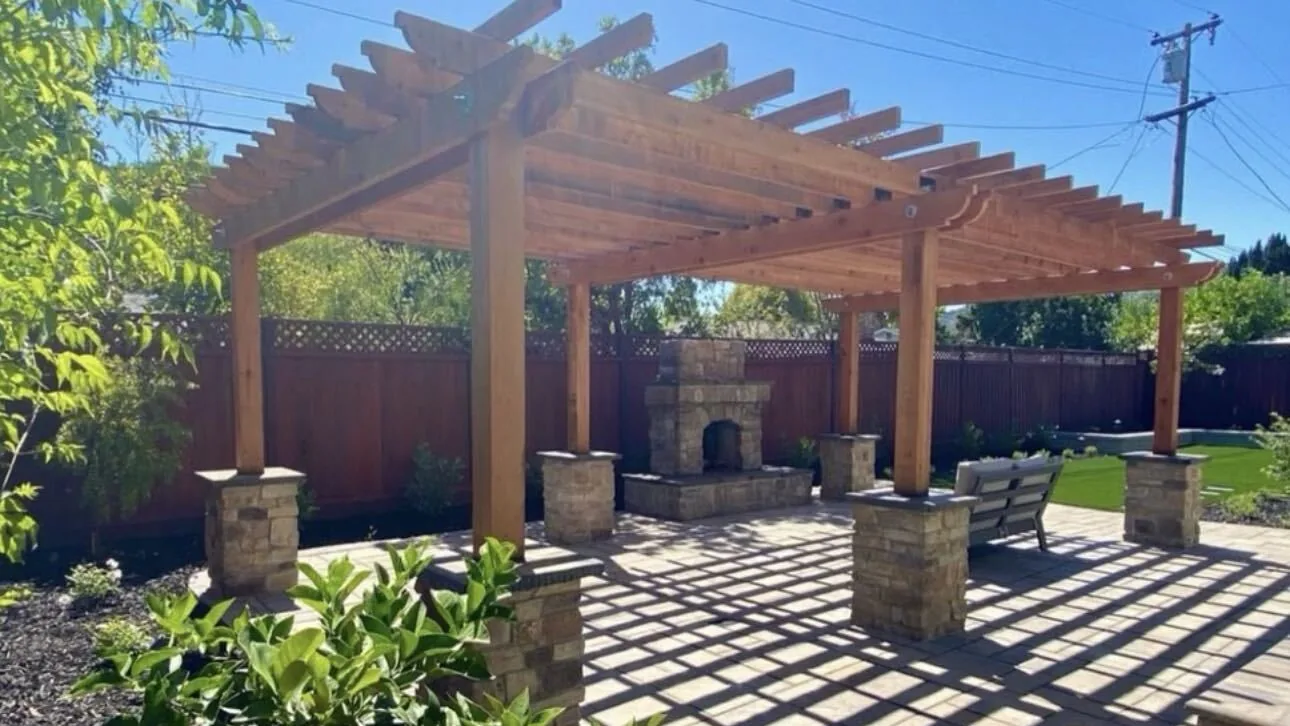
Do You Need a Permit for a Pergola or Patio Cover in Monterey County?
Usually yes for a patio cover, and often yes for a pergola. Neither one appears on California’s list of work that is exempt from a building permit. Before anything gets built, ask the building counter that covers your address.
The item that causes confusion is the 120 square foot exemption. It is written for one-story sheds and playhouses. Unincorporated Monterey County raises it to 240 square feet for sheds and playhouses with no electrical, plumbing or mechanical work. Neither one is a pergola rule or a patio cover rule.
The list also exempts small window awnings that hang off the wall and need no extra support. A patio cover standing on posts is not that item. So plan on a permit for a roofed patio cover on posts, attached or freestanding, until the counter that covers your address says otherwise.
Monterey County adds a trigger of its own. Its building FAQ says a structure “of any size that contains utilities requires a building permit.” Wiring for a fan or lights counts, and so does a gas line.
We build pergolas and patio covers across the Monterey Bay area. We check with the building department before we build, and the building permit is the first layer. Design review and coastal rules can sit on top of it, and so can fire hazard zone rules.
Who issues a pergola permit or a patio cover permit?
It depends on whether the house sits inside a city. Inside city limits, the city’s building division issues the permit. Unincorporated places like Pebble Beach, Carmel Valley and Prunedale go through the county. There, the Permit Center at Monterey County Housing and Community Development (HCD) handles it.
| Where the house sits | Who issues the building permit | What the published guidance says |
|---|---|---|
| Unincorporated Monterey County | County Housing and Community Development | A structure of any size with utilities needs a permit |
| City of Monterey | Building and Safety Division | Patio covers are on its list of work that needs a permit |
| Pacific Grove | The city’s building department | ”A building permit is required for almost all projects” |
| Carmel-by-the-Sea | The city | Planning approval for most exterior alterations |
| Salinas, Seaside and Marina | The city’s building division | Confirm with the city’s building division |
The City of Monterey’s building FAQ lists patio covers under “Permits are also required for.” It also tells owners to “Check with the Building and Safety Division before starting any project.”
Local offices can change the state list, and the county’s 240 square foot shed rule is one of those changes. The current statewide code is the 2025 California Building Standards Code, which took effect January 1, 2026. Confirm the rule with the office that covers your address.
Can design review apply when no building permit is needed?
Yes, in parts of the county. Monterey County requires Design Approval in its Design Control areas. Those areas carry a D, S or VS overlay in the zoning. That review looks at a structure’s exterior look, location, size, materials and colors.
Every parcel in the Carmel and Del Monte Forest coastal land use plan areas is a Design Control area. In those areas, the county lists “Construction of any new structure or building” as work that needs Design Approval. It also says “projects which do not require a building permit may require Design Approval.” So a pergola in Pebble Beach can need design review even with no building permit.
In Carmel-by-the-Sea, most exterior alterations and site coverage changes need Planning approval. A 2019 city memo on its zoning lists arbors and trellises up to 7 feet tall. Its table shows that height in the front, side and rear setbacks. Treat that number as orientation only and confirm the current rule with the City.
Pacific Grove’s planning FAQ says “Anytime you are changing the exterior of a building, you need a planning permit.” The city wants that planning permit before you apply for the building permit. Ask the city whether your cover counts as an exterior change.
What does the coastal zone add?
If your home sits in the Coastal Zone, another review sits on top of the building permit. In unincorporated Monterey County, every Coastal Zone project that needs a building permit goes to Coastal Planning staff. They decide whether a Coastal Permit is required. The county says the majority of those projects are approved with a Coastal Exemption instead of a full Coastal Permit.
The California Coastal Commission states the general rule. Coastal zone development “generally may not commence until a coastal development permit has been issued.” The Commission or a local government issues that permit. Inside a coastal city, ask that city how the rule applies to your cover.
Do fire hazard zones change how a cover is built?
In a mapped fire hazard zone, they can. California’s wildfire rules cover miscellaneous structures attached to a house or less than 3 feet away. Those must be noncombustible or ignition-resistant. Ask the building counter whether your address sits in a mapped zone and how the rule reads for your cover.
The state Board of Forestry has published a draft Zone 0 rule for the first five feet around a home. The April 2026 draft would count an attached pergola as part of the house when that zone is measured. The same draft would keep the ground under pergolas, decks and stairs free of vegetation and combustible items. Treat it as a draft and ask what applies on the day you build.
Do setbacks and site coverage still apply?
Yes. Monterey County says even a structure that needs no permit must meet setback and design review rules. Its FAQ tells owners to “consult with a Department planner to determine setback requirements.” In Carmel-by-the-Sea, a site coverage change goes through Planning approval too.
Decks have their own item on the state’s exempt list, with its own tests. If the cover sits on a redwood deck, ask about the deck and the cover together.
Some covers shelter an outdoor kitchen with a gas line or lights. In unincorporated Monterey County, the utilities rule then applies at any size. We run gas and electrical work through licensed trade contractors.
A patio on a slope may also need a wall to hold the grade. Our retaining wall permit guide covers that permit.
What should you do before you build?
Start with the address. Find out whether it sits inside a city or in the unincorporated county, then call that building counter. Ask about the building permit, design review, the coastal zone and fire hazard zones in the same call.
We check with the building department before we build, and we build to the approved plans. Our crew pours the footings and frames the cover, with posts on plain bases or stone veneer column bases. See our pergolas and patio covers page for how we build them. For a free estimate, call or text (831) 262-9943.
This guide is general information, not legal advice. Confirm every rule with the building department that covers your address.